


When ChatGPT first entered the commerce scene, most brands filed it under “future curiosity” - something to keep an eye on, but not a platform shaping real retail moves. Fast forward to today, and the conversation has changed. Our latest modeling via Flywheel Retail Insights points to a future where ChatGPT could be a commerce force driving the full shopping journey, at a scale that could put it shoulder-to-shoulder with the likes of Walmart.com by 2030.
From research tool to storefront: how ChatGPT became a commerce channel
ChatGPT started as a research tool - shoppers asked questions and got instant answers. With OpenAI's "Instant Checkout" enabled for select Etsy sellers, Shopify merchants, and Walmart products, it’s now a storefront. Others are taking different approaches: Target is building an app inside ChatGPT, while Instacart is enabling full-basket grocery shopping with instant checkout. The shift is clear: checkout is moving into the chat.
ChatGPT is quickly becoming a true commerce channel, and you need to prepare to treat it like you treat Amazon, Walmart, or any other retail platform.
Three scenarios we see for ChatGPT’s growth
While it's impossible to fully predict the path of ChatGPT as a retailer, we see three distinct scenarios for ChatGPT’s rise, each telling a different story about just how much of the digital shelf it might claim, if it continues on it’s current trajectory and captures ~50% of Google’s current web traffic by 2030.
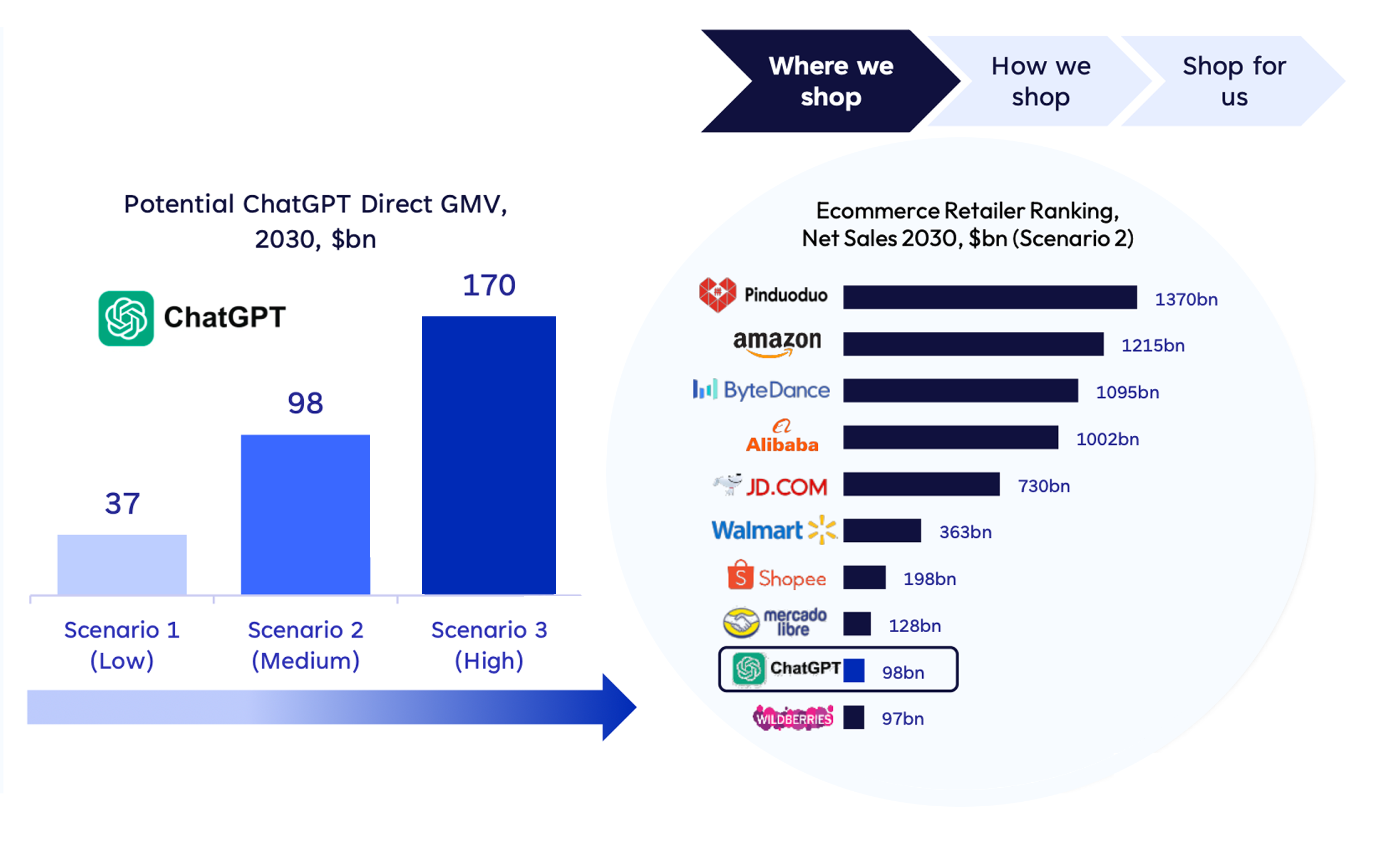
Source: Flywheel Retail Insights' 2025 Agentic Commerce report
In the lowest growth scenario, ChatGPT emerges as a formidable new entrant, growing faster than many established players, but not quite breaking into the top tier. In this scenario, shopping-related searches reach around 10% of total ChatGPT, and most transactions continue to redirect to third-party retailers rather than convert within ChatGPT's platform (only ~10% of revenue stays in-app). It’s the kind of disruption that makes everyone sit up and rethink channel priorities, but it doesn’t redraw the map overnight.
Move to the medium growth scenario, and suddenly ChatGPT is rivaling regional players like Mercado Libre. Here, shopping queries grow to ~13% of ChatGPT searches, and ChatGPT begins capturing more in-platform transactions (~20% of revenue). Consumers become more comfortable shopping directly within the app, and ChatGPT's checkout experience improves significantly. Growth patterns echo what TikTok Shop and Temu have pulled off in their first five years - fast, broad, and hard to ignore.
And then there’s the high growth scenario: ChatGPT jumps to the 8th largest eCommerce player globally, and is comparable in size to Walmart.com. This requires shopping searches to reach 15% of all ChatGPT queries, and a substantial shift in behavior where ~30% of transactions occur directly in-app through features like Instant Checkout. Consumer trust in shopping on ChatGPT solidifies, the checkout experience becomes frictionless, and the platform becomes a default retail destination.
So, what does this mean for brands and retailers trying to plan when so much still depends on which path becomes reality?
For retailers, it’s a choice of partnering or building
Retailers have a choice: double down on proprietary AI shopping assistants (think Amazon’s Rufus) to keep control and data in-house, or partner with ChatGPT, similar to Walmart, Target, and Shopify, to extend reach but cede some shopper ownership.
In the lower-growth scenario, owning the shopper data and experience may still pay off. However, as ChatGPT’s share grows, the cost of going at it alone rises. In the medium and high growth scenarios, integration and collaboration with leading AI platforms becomes less a nice-to-have and more a competitive necessity.
The retailers who pull ahead will need to share data in real time and meet shoppers wherever the most trusted AI agents point them - even if that’s off their own site.
For brands, GEO is the new digital shelf
Regardless of which growth trajectory ChatGPT is on, optimizing for GEO is a necessity. Yes, it may take time for shoppers to adopt checkout within the app, but they're already discovering products there. If your products aren't optimized for GEO, they can't be found - and you'll fall behind competitors who moved faster.
Visibility will depend equally on traditional SEO and Generative Engine Optimization (GEO). Are your specs, images, and attributes clean and consistent across every retailer feed? Can your content answer the questions AI agents pull from shoppers - such as “What are the best women’s shoes for marathon training?” not just “women's running shoes”? The brands that win in the medium and high growth scenarios will be those that treat GEO like a new channel, optimizing content not just for search but for conversation.
Looking ahead: mass personalization at scale
In all of the forecasted scenarios (but especially if ChatGPT breaks into the top 10 eCommerce retailer ranks) AI agents will drive bundles, routines, and recommendations tailored to each shopper’s journey. Combine that with improvements in data accessibility for brands, and winning loyalty comes down to three things: differentiated content, dynamic offers, and reaching the right audiences in a personalized way. When paid media is layered in and clean rooms continue to advance, brands that optimize each of these elements will pull even further ahead.
And what about the shoppers themselves? Imagine a world where you ask ChatGPT for the best protein powder for runners, and it not only recommends and compares options but places the order, tracks your delivery, and nudges you to reorder just as you run low. In every scenario, the brands that shoppers trust - because their data is accurate, their recommendations are clear, and their offers feel personal - will win.
So, what should your next moves be? Here’s where we’d start:
Audit your content across retailer channels, ensuring for accuracy and consistency to increase the likelihood of AI agents highlighting your products in relevant queries.
Experiment with the various existing AI agents, asking questions and studying the products it outputs.
Treat GEO like its own channel, not just a tweak to SEO – use natural language and make sure that your content is set up to answer the typical questions a shopper might ask an algorithm.
Build AI expertise across your organization to prepare for ChatGPT as its own retail channel.
Brands who act now will pull ahead
The age of agentic commerce is here, and ChatGPT is only the beginning. Brands who act now - updating their data, content, and measurement for AI-powered journeys - will lead the next decade of retail.
If your team is ready to turn these insights into your 2026 plan, let’s connect.

Ready to grow your business?
Let's discuss the best approach to meet your brand's specific needs.
Let's connect