

Social commerce has been hyped for years. In 2026, it’s finally where the real growth starts to show up in the numbers.
In Flywheel Retail Insights’ Digital Trends to Prepare for in 2026 report, social commerce stands out as one of the clearest shifts in where incremental revenue will come from over the next few years. One platform in particular, TikTok Shop, is already reshaping that growth, and our data suggests it’s big enough to warrant a playbook that’s distinct from your traditional social strategy.
Social commerce is becoming a full-funnel growth engine
Social is now an end‑to‑end commerce environment. Treating it as an upper‑funnel experiment undersells how much revenue is already flowing through it. There are two key behavioral shopping dynamics that have caused this shift, driven by the emergence of TikTok Shop:
Content, discovery, and commerce are collapsing into one experience: Short‑form video, live shopping, and creator posts are doing the work that used to happen across a dozen touchpoints. Education, social proof, and a path to purchase now live inside a single scroll.
Creators are the new storefronts: Consumers increasingly trust creator content and community recommendations more than brand‑only messaging, and leading brands are now lifting those social‑first campaigns into CTV and off‑site media as reusable creative that drives directly back to retailer and brand destinations.
TikTok Shop has rewired the path to purchase, and social commerce is maturing into a full‑funnel growth engine with rapidly improving closed‑loop measurement. Brands that still fund it as an awareness channel are out of step with how consumers are actually discovering, evaluating, and buying.
ByteDance is on a retailer trajectory, not a media one
If TikTok Shop’s impact on consumer behavior isn’t enough on its own, the numbers should be. ByteDance, TikTok’s parent company, is the clearest signal that social commerce has crossed over from media channel to true retailer territory. We’re forecasting that:
TikTok Shop will generate around $87B (USD) in GMV in 2026, growing roughly 56% year over year.
By 2030, TikTok Shop will be the 7th‑largest eCommerce retailer globally, while Douyin is projected to rank 4th.
ByteDance’s market share of global eCommerce sales will be 14.6%, just trailing Amazon’s 15.9% by 2030.
ByteDance, TikTok Shop’s parent company, will become the third largest global retailer by 2030.
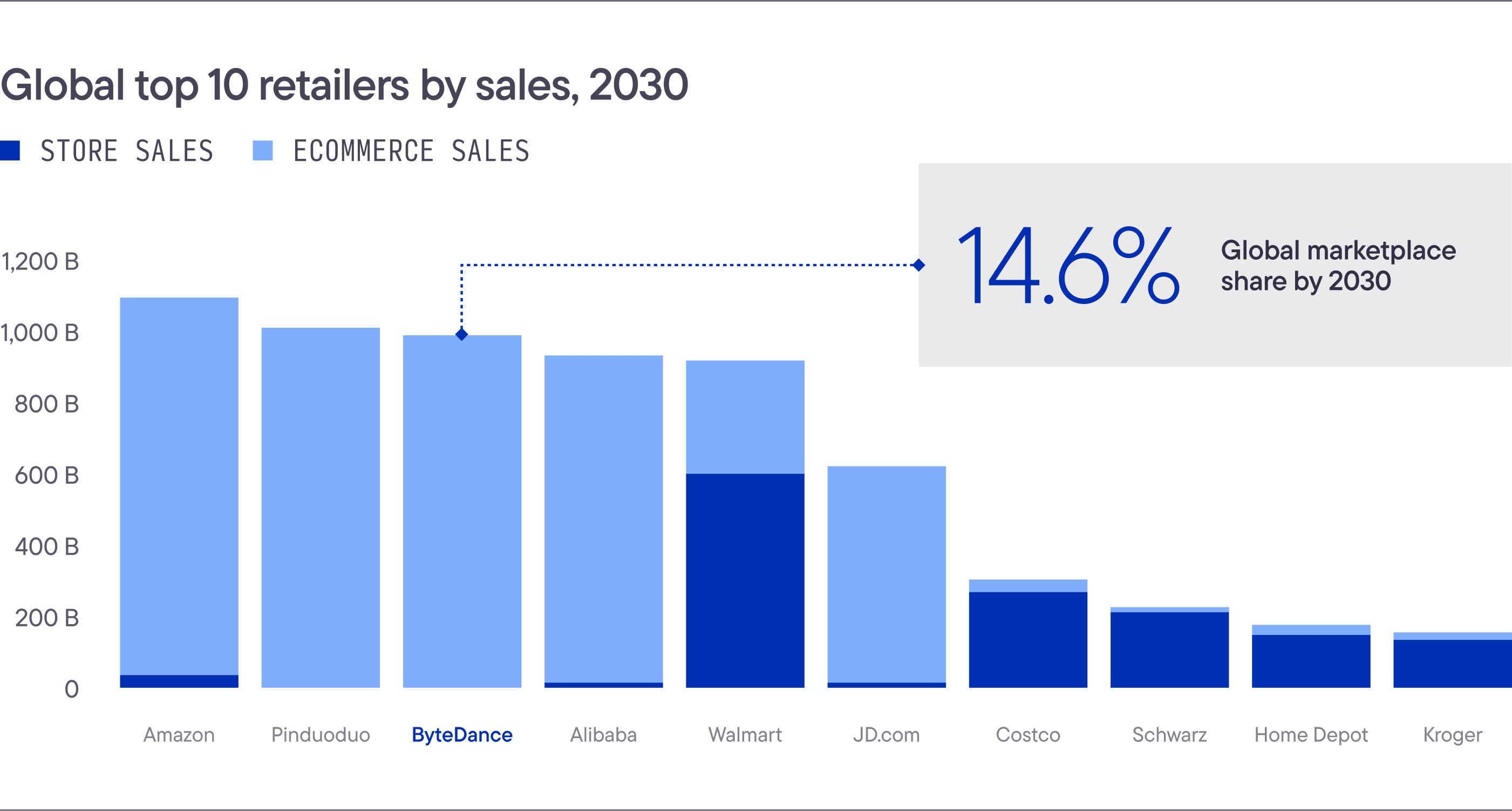
Those projections put ByteDance in the same marketplace view as Amazon, Walmart, Alibaba, Temu, Shein, and regional leaders. In that context, TikTok Shop and Douyin are more than media powerhouses, they’re meaningful contributors to global retail share.
If you’re planning for 2026 and beyond, TikTok Shop needs to sit alongside your other retail channels in the portfolio, not off to the side as a social experiment.
Why TikTok Shop requires a different kind of playbook
A standard social playbook won’t equip your brand to win on TikTok Shop. Our latest playbook, "TikTok Shop Unlocked: The ultimate brand playbook for turning views into profitable growth," focuses on four elements that we see separating early winners from everyone else:
Choosing products that naturally fit into the culture of TikTok’s feed
Working with the right creators to get your message in front of high-intent consumers
Designing your sampling and content strategy for scale
Amplifying winning content to boost conversions with paid ads
The tactical “how” behind these shifts lives in the playbook. The important takeaway is here: a profitably scalable TikTok Shop strategy is possible, but it depends on making deliberate choices across product fit, creator strategy, content, and media.
What you can start doing now
Before you read the playbook, there are some actionable steps you can take now to get started on TikTok Shop:
Right‑size TikTok Shop in your 2026–2027 portfolio: Look at ByteDance’s projected share alongside your current channel mix. Even a directional target for TikTok Shop’s role will change how you budget, staff, and prioritize the channel.
Elevate social commerce in internal planning: Make sure the same teams who own marketplaces and retail media are part of your social commerce conversations. Social‑driven GMV can’t live in a silo under “brand” or “social” if it’s going to scale.
Define what “creator‑led content” actually means for your brand: Clarify where you need to hold the line on brand and claims, and where you’re willing to give creators room to sell in their own voice. Those decisions will shape who you can work with and how fast you can move.
Audit your content and data for social‑commerce readiness: Check whether your product information, creative assets, and reporting structures are built for short‑form video and live selling, going beyond search and static PDPs.
Each of these steps fits with how you operate today, but they become far more powerful when they’re anchored in a clear view of where social commerce, and TikTok Shop in particular, is headed.
Going deeper with Flywheel’s TikTok Shop playbook
If you want the full “how,” our TikTok Shop playbook provides actionable tactics for brands looking to turn views into profitable growth. If your team is ready to put a real TikTok Shop strategy on the roadmap for 2026, this is where to start.

Ready to grow your business?
Let's discuss the best approach to meet your brand's specific needs.
Let's connect