TikTok Shop moves quickly. More than 23 million videos are uploaded to TikTok every day, creating a constant competition for attention.
For brands, that makes video volume essential. The traditional response has been straightforward: send products to as many affiliates as possible and hope enough of them post. T
hat approach is easy to understand. It is also expensive, inefficient, and increasingly difficult to scale.
The problem with a volume-first approach
We analyzed data from Reacher and found that 86% of affiliates generate zero sales. Sampling data tells a similar story: 53% of samples do not lead to any video, while another 37% lead to only one video (Source: Reacher’s 1.5 million sample portfolio). That means fewer than 10% of samples result in the repeat content brands need to break through.
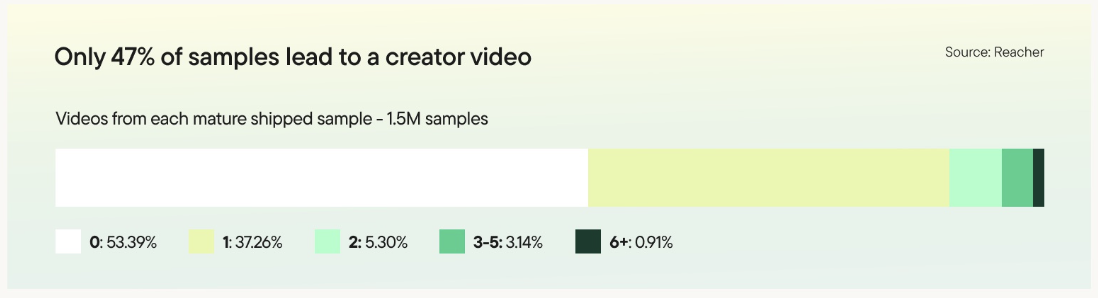
Every sample that does not generate content carries a cost. There is the product itself, shipping, campaign management, and the time required to recruit and coordinate creators. When the majority of samples produce no sales and many do not produce any content, the economics become difficult to defend.
The challenge is especially important for brands entering TikTok Shop. Only 14% of brands reach $100,000 in GMV within their first 90 days, according to Reacher data. The difference between those brands and everyone else is how effectively they use sampling to identify creators, generate repeat content, and build a system that improves over time.
Sampling should be a filtering mechanism
A more efficient strategy starts by treating sampling as a test. Instead of identifying the perfect group of creators before sending the first sample, brands should recruit a diverse initial group, evaluate who creates content and drives sales, then focus future resources on the creators who show potential.
That means the first sample is only the beginning of the relationship. It is a way to learn:
Which creators understand the product?
Which audiences respond to the content?
Which messages and formats drive action?
Which creators continue posting after the first collaboration?
Which affiliates create content that converts?
The answers create a more useful foundation for the next round of sampling.
The goal is more content from each sample
Reacher’s data shows that brands reaching $100,000 in GMV within their first 90 days see each creator produce an average of 2.5 videos. That repeat activity matters because GMV per video increases as creators continue producing content for the same product.
From this same dataset, we see that creators generate an average of $7.19 in GMV per video when they post once. By videos three through five, that increases to $14.16 per video. Creators producing 20 or more videos generate an average of $74.07 per video.
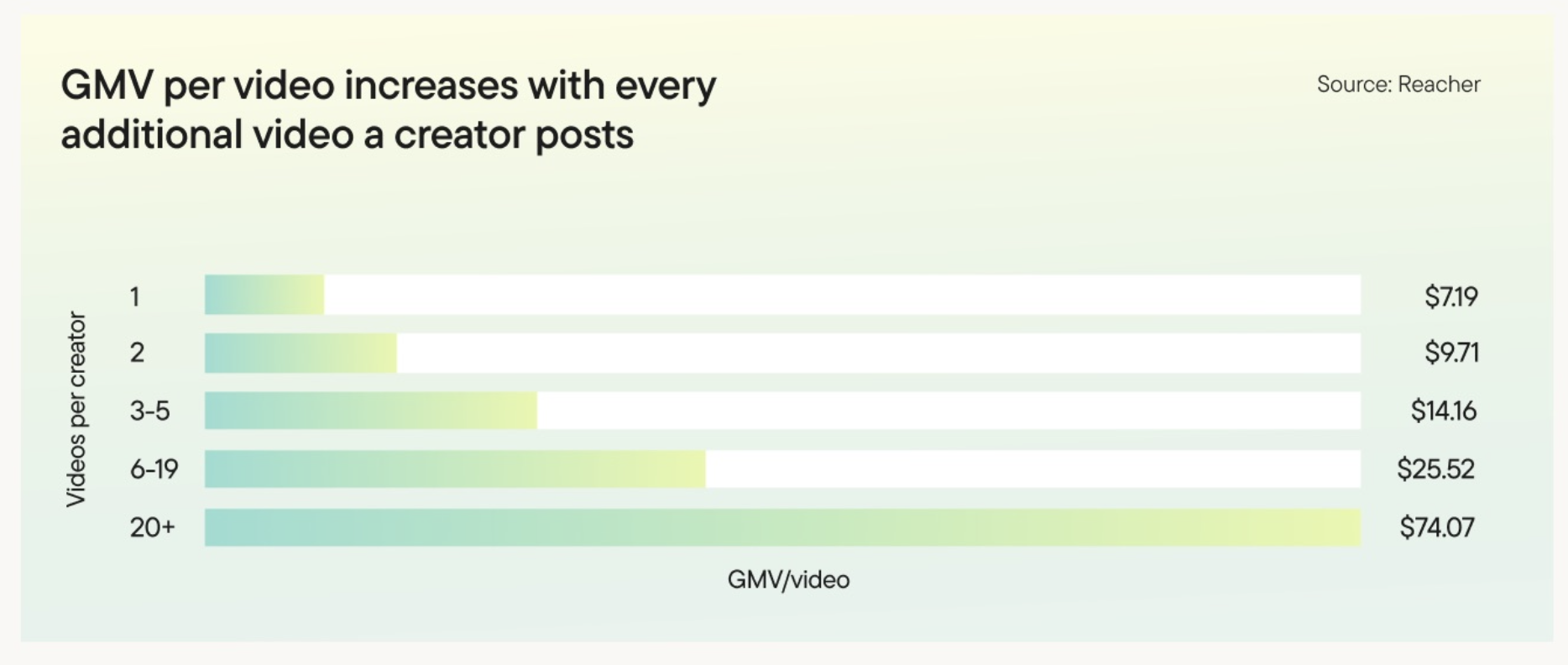
The lesson is clear: sample efficiency is not just about how many products leave the warehouse. It is about how much useful content and commercial value each sample creates.
Build the foundation before sending samples
Creators are more likely to produce multiple videos when they understand the product, know what messages matter, and have a clear path to improvement. That foundation can include:
Clear brand guidelines and content briefs
Product education and talking points
Examples of successful hooks and formats
Feedback on early content
A community hub for updates, challenges, and support
Performance information that shows creators how their content is working
A sample by itself gives a creator a product. A structured program gives them the tools to create better content and a reason to keep participating.
Make the next sample more strategic than the last
The strongest sampling programs become more selective over time.
After the first round, brands can identify creators who:
Produce content consistently
Reach a relevant audience
Generate meaningful engagement
Drive sales
Continue posting without constant prompting
Those creators should receive more attention, stronger incentives, and earlier access to new products or bundles. That approach helps brands reduce waste while building a more reliable creator network.
How to improve your TikTok Shop sampling strategy
TikTok Shop success still depends on video volume. The strategic question is how efficiently a brand generates that volume. Sending more samples can create more opportunities, but a system built around creator selection, repeat content, education, and incentives creates more durable growth.
For the full framework, including how to build the right foundation, select creators, and create repeat incentives, read TikTok Shop Amplified: How brands generate more GMV from every creator.

Ready to grow your business?
Let's discuss the best approach to meet your brand's specific needs.
Let's connect